
Switching firms? Here’s a breakdown of what to consider before you sign.
Our Chief Strategy & Growth Officer, Jeff Acheson, says we’re like Navy SEALs. When the boat’s moving in the wrong direction, we’re not the Titanic. We can get out of the path of the iceberg.
A legacy liner, fixed and hierarchical. A nimble boat, with real service and direct access to leadership. Which one should an advisor choose today?
What we hear
Recruitment told an advisor he’d get a 93 to 95% payout. He ran his own numbers and landed at 80%. Platform fees took a slice; admin fees took another. Fifteen percent gone without a transparent view into where it went.
One saw his firm’s revenue grow 48% while his grew significantly less. A third couldn’t rebalance a client’s account without filing a ticket first. He lost a $9 million relationship waiting on the client agreement process.
Another found out his firm had been sold from a CNBC headline, on a Friday, same as every other viewer. From three thousand advisors to 33,000. No call or warning. Just a news crawl.
Questions to ask when choosing an advisor platform
First, crunch the numbers.
- What’s my actual payout at my production level, and how does the grid move as I grow?
- What fees come out before I see that number — E&O, tech, compliance, ticket charges?
- If there’s a transition bonus, what’s the vesting and clawback schedule?
Next, probe who actually owns your book.
- Who owns the client relationship and data if I ever leave, me or the firm?
- What happens to my book if I want to go independent or switch platforms down the road?
Then, figure out flexibility and custody.
- Can I use multiple custodians, or am I locked into one?
- Is there pressure toward proprietary products, or is it truly open architecture?
What the transition looks like matters more than you may think.
- Is there a dedicated team helping with the move, and for how long?
- How long until I’m fully operational — accounts transferred, tech live, compliance cleared?
And last, culture. This is what makes or breaks your decision.
- What does an advisor who thrives here look like?
- What’s changed in the last couple years that advisors didn’t love?
- Is advisor headcount growing or shrinking, and why are people leaving, if they are?
Did you know there’s an alternative?
What even qualifies us to say there’s a better way? For just over 30 years, IFP has partnered with financial professionals to strengthen their firms, support their clients, and give them back time to grow their business. Our advisors are independent but not alone, able to build real relationships with people who know their name and their case.
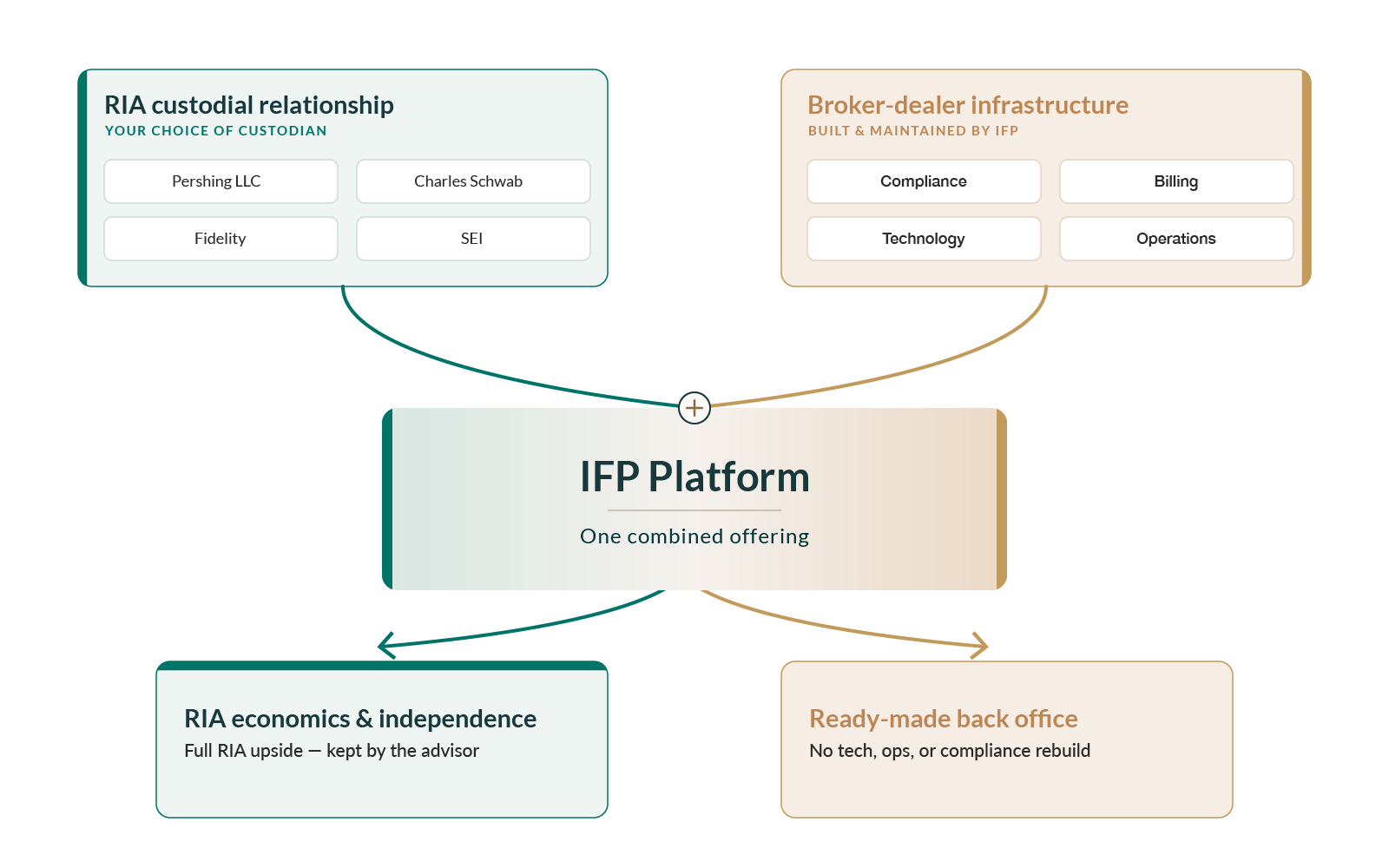
The difference is in the model. Many advisory firms have both a broker-dealer and an RIA — the structural distinction is custody. Legacy BDs hold client assets themselves. We move those assets to an independent custodian and handle the paperwork, compliance, and billing in-house. An IFP advisor gets support from two places instead of one: the custodian directly, and us, running their back office.
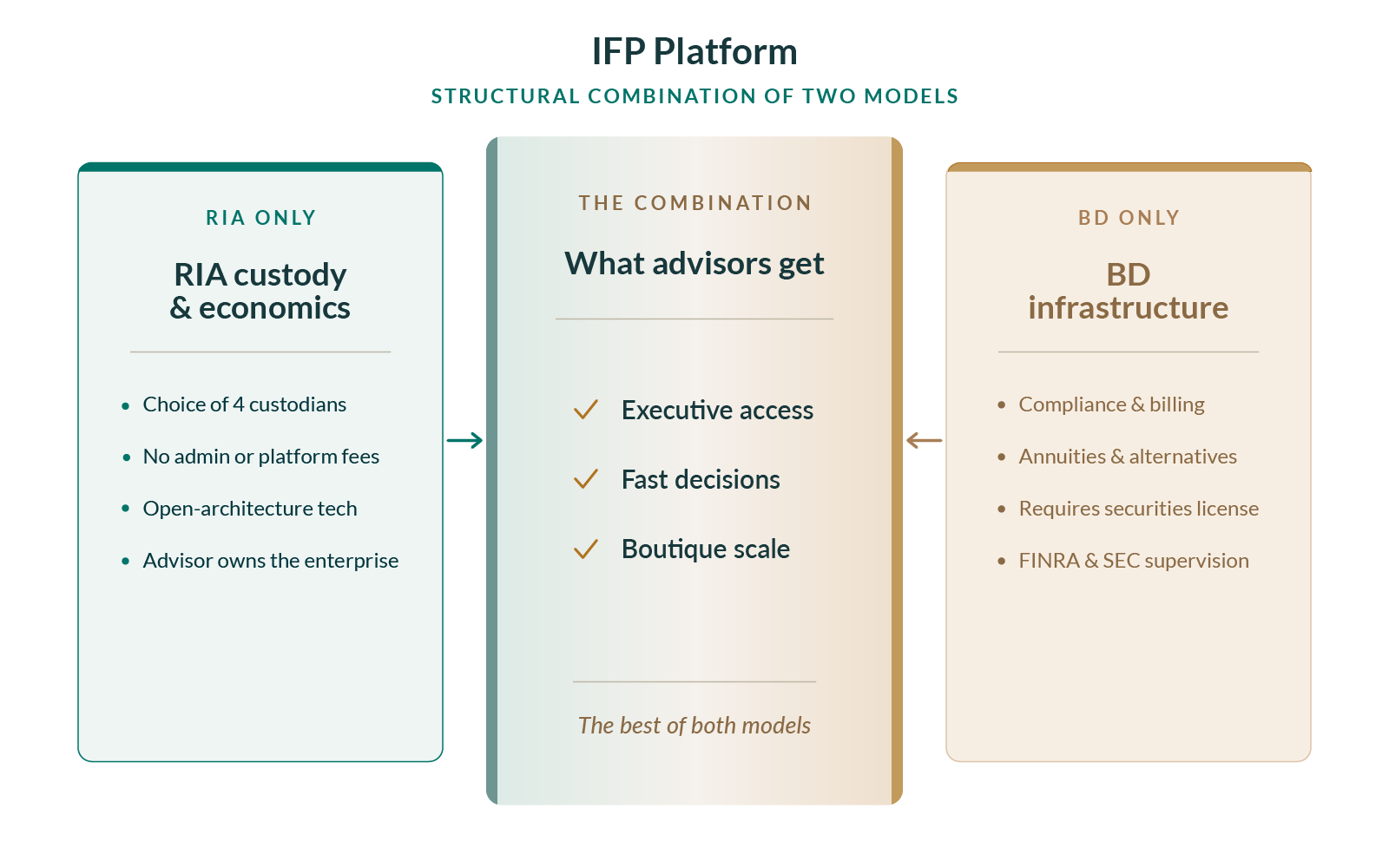
Does a legacy BD still sound safer and steadier? That depends on how you define either term. We’re a boutique firm with 286 professionals across 37 states (as of 7/22/26) — established, but still small enough to give you white-glove service, with less red tape and faster decisions. When a problem comes up, we deal with it directly, instead of routing it through layers of approval until it (inevitably) escalates.
Why legacy BD advisors make the switch — feat. Commonwealth case study
So far, four former Commonwealth advisor teams have joined us as of Sept. 1, 2026, representing more than a billion dollars in client assets.
Here’s the backdrop: LPL bought Commonwealth Financial Network in March 2025. For many, staying with LPL is the path of least resistance. But not every advisor wants to be one in a score of thousands.
What were advisors who wanted more than the default option looking for?
It starts with a gut feeling: this isn’t the culture I want. Once they talk to us, the difference sinks in: no micromanagement, no forced tech stack, no mandated custodian. What they find is an independent, RIA-leaning setup with direct access to our executive team. Above all, they plain old just like the people they’re speaking with.
Here’s how Justin Kain, our Director of Recruitment, put the experience at legacy BDs: “[Firms] are coming with these 10, 12, 15-year lockups, where advisors are selling their soul for the upfront dollars,” he said. “They’re losing a lot of the flexibility, and a couple years into the contract, they’re not happy — and they’re trying to figure out how to unwind that unhappiness.”
The simplest course of action isn’t always the right one. When asked what they want from a new partner, advisors get specific: independence without isolation, fewer hours on busywork, a firm that ranks service above payout, access to products they’d been told no on for years.
CenterBridge came first. It started with a webinar. One of their partners heard something that broke an assumption he’d carried for years, that going RIA with Fidelity meant going it alone.
What we offered didn’t fit the category he expected. We give advisors an RIA custodial relationship with Fidelity or Schwab, combined with the compliance, billing, technology, and operations of a traditional broker-dealer. A call with CEO Chris Hamm and Executive Chairman Bill Hamm confirmed the fit. They wanted to keep the community and support they already had, while finally getting the RIA economics and ownership they’d wanted for years.
The latest to join us are Severn Financial Advisors and Van Horn Financial Services.
Carly James put it simply. What sold her on Severn’s move was the people. “From our first conversations, the team was transparent, accessible and genuinely invested in helping us succeed,” she said. “We wanted a partner that wasn’t just prepared for where the industry is headed, but excited about it, and that’s exactly what we found at IFP.”
Graham Van Horn found it in the structure. “It was important to find a firm that would allow us to maintain ownership of our business while providing the flexibility, resources and support to continue growing,” he said. “IFP’s hybrid model, multi-custodial platform and forward-looking approach gave us confidence that we could preserve what makes our firm unique while gaining the capabilities we need to better serve clients and continue growing for the long run.”
These teams join advisors we’ve worked with for years, across every kind of transition. So, is our model the right fit for you? Not necessarily. Some will do just fine at LPL. Others want the full independence of a standalone RIA. But if you valued Commonwealth’s culture, community, ease of operation — and you’re worried about losing those values inside a 30,000-advisor platform, we should probably talk. Justin says it best. Advisors happy with their contract don’t take our calls. Will you?